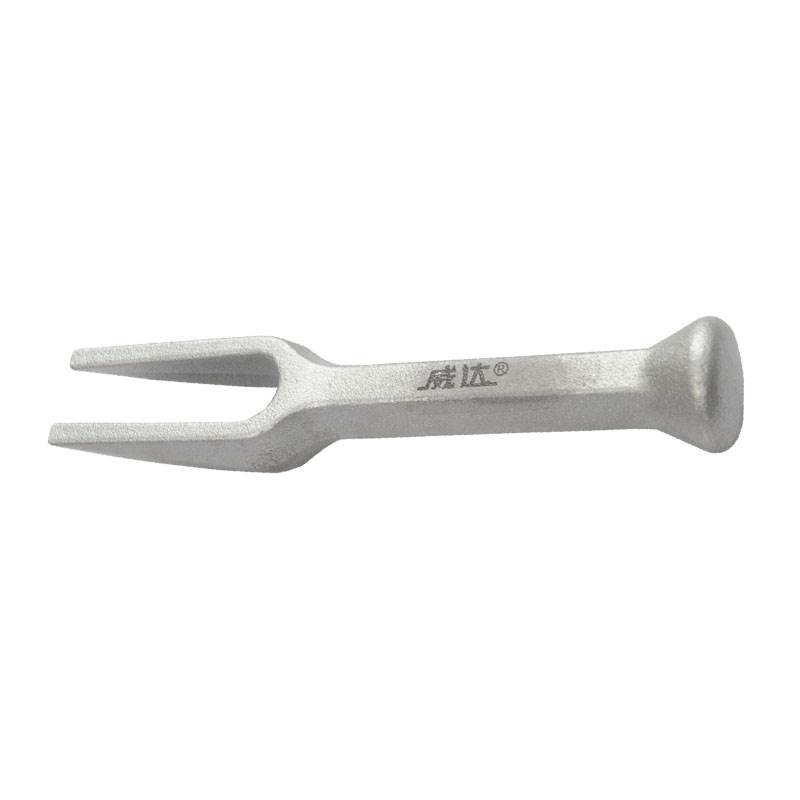
Product Overview
The W40729 Ball Joint Separator Fork — commonly known as a pickle fork or tie rod fork — is a classic hammer-driven chassis tool built for fast separation of tie rod ends, control arm ball joints and suspension linkage studs.
Manufactured from premium alloy steel by one-piece drop forging, then quenched and tempered, it delivers a rigid fork body that resists spreading and a struck end that resists mushrooming. The compact 200 mm length combined with a slim twin-fork profile slides easily into the narrow gap between the joint and the knuckle, making it ideal for cramped chassis areas packed with surrounding components — exactly where screw-type pullers cannot fit.
In use, simply wedge the fork between the ball joint and its mounting, then strike the end of the handle with a hammer. The tapered wedge faces generate enormous separating force, popping a seized ball stud out of its taper in seconds — far faster than screw-type compression. An essential efficiency tool for every workshop.
Key Features
- Premium Alloy Steel Drop-Forged — One-piece forging, no casting porosity, impact-resistant and hammer-proof
- Twin-Fork Wedge Design — Slim tines enter easily; progressive wedge action separates efficiently
- Compact 200 mm Length — Purpose-built for tight spaces where longer tools cannot reach
- Hammer-Driven Fast Separation — Strike the handle end and the joint releases in seconds
- Reinforced Striking End — Upset-forged and tempered to resist mushrooming and cracking
- Hardened Fork Tines — Wedge faces stay sharp after long-term use
- One-Piece, Weld-Free — No hidden cracks at stress points; safe and reliable
- Anti-Corrosion Finish — Plated / black-oxide treated for oily, humid workshop conditions
- Individually Boxed — 1 pc per box, 36 pcs per carton, ideal for retail and shelf display
Specifications
| Item | Detail |
|---|---|
| Item No. | W40729 |
| Pulling Length (Overall) | 200 mm |
| Material | Premium alloy steel, drop-forged + heat-treated |
| Finish | Electroplated / black-oxide anti-rust |
| Type | Twin-fork wedge (hammer-driven) |
| Operation | Strike the handle end to separate components |
| Working Space | Suitable for confined spaces |
| Inner Box | 1 pc |
| Carton Qty | 36 pcs |
| Net Weight | 0.69 kg / pc |
| Gross Weight | 25 kg / carton |
Applications
- Dealerships and repair shops — steering and chassis service
- Fast tie rod end separation
- Upper and lower control arm ball joint removal
- Sway bar / stabilizer link separation
- Drag link and steering arm stud removal
- Brake linkage and connecting rod joint separation
- Assisting shock absorber lower mount and bushing removal
- Pickup, SUV and light truck chassis maintenance
- Vehicle dismantling and used-car reconditioning workshops
- DIY car owners’ chassis repair tool kits
Fork Type vs. Screw Type — Which to Choose?
| Comparison | Separator Fork (W40729) | Screw-Type Ball Joint Puller |
|---|---|---|
| Speed | Seconds | Gradual pressure needed |
| Tight-Space Access | Slim tines fit anywhere | Limited by frame size |
| Dust Boot Protection | Destroys boot | Boot preserved |
| Force Control | Requires experience | Smooth and controllable |
| Price | More economical | Higher |
| Best For | Scrapping old parts, fast teardown, tight areas | Precision work, reusing original parts |
💡 Professional Tip: The two tool types are complementary — we recommend stocking both. Distributors can bundle them to increase order value and customer satisfaction.
Why Choose Us
- 20+ Years of Automotive Tool Manufacturing — Specialists in ball joint separators, pullers and chassis tools, with in-house forging, machining, heat treatment and finishing lines.
- Genuine Alloy Steel — Forged from premium alloy structural steel, quenched and tempered; mill certificates and SGS reports available.
- Drop-Forged with Dual Heat Treatment — Hardened tines for wear resistance, tempered striking end for toughness — the best of both properties.
- Not Cast, Not Welded — No porosity or hidden cracks at load points, eliminating the risk of shattering.
- Impact-Tested — Repeated hammer-fatigue sampling before shipment ensures durability well beyond field requirements.
- Complete Product Line — Additional fork sizes plus 17/20 mm screw-type ball joint pullers and 18.6 mm tie rod pullers for bundled supply.
- Direct Factory Export Pricing — No middleman markup; strong margins for wholesalers and distributors.
- Full OEM / ODM Service — Custom logo laser engraving, steel stamping, paint colors, blister hang cards, color boxes, blow-molded cases and barcodes.
- Strict Quality Control — ISO 9001 system with 100% visual inspection, hardness sampling, impact testing and salt-spray testing.
- Stock Availability & Fast Lead Time — 7-15 days for stock orders, 30-45 days for customized orders.
- Global Export Network — Supplying 60+ countries across Europe, North America, the Middle East, South America and Southeast Asia.
- Full After-Sales Support — 12-month warranty with free replacement or refund for genuine quality defects.
FAQ
Q1: What is your MOQ?
A: 1 carton (36 pcs) for stock items; 500 pcs for custom-logo orders.
Q2: How is this tool used — really with a hammer?
A: Yes. Wedge the twin fork into the gap between the ball joint and its mounting, then strike the end of the handle with a hammer. The wedge action forces the stud out of its taper. It is the fastest method available, usually taking just a few blows.
Q3: What does 200 mm cover, and where does it fit?
A: 200 mm is the overall length — a compact size designed for confined chassis spaces such as the inner side of a steering knuckle or above a control arm, where longer tools cannot reach. Other lengths and fork openings are available if you need more leverage or a wider gap.
Q4: Will it damage the ball joint dust boot?
A: Yes. A pickle fork is a destructive separation tool — wedging inevitably tears the rubber boot. It is therefore recommended only for joints that are being replaced. To remove and reuse the original joint, choose a screw-type ball joint puller (available in 17 mm / 18.6 mm / 20 mm).
Q5: Is the material really alloy steel? Can it be verified?
A: Yes — premium alloy structural steel, drop-forged, quenched and tempered. Material certificates or third-party (SGS / BV) testing can be arranged on request.
Q6: Will the striking end mushroom or crack?
A: The struck end is upset-forged and tempered for a balance of hardness and toughness, and withstands long-term repeated hammering in normal use. Use a 1-2 lb hand hammer rather than a sledge, and avoid angled blows. Replace the tool if severe mushrooming or cracking appears.
Q7: Can I drive it with an air hammer?
A: Yes, an air hammer can be used to speed things up, but choose an appropriate power level and limit run time to avoid fatigue damage to the tool or deformation of the joint housing. Manual hammering offers better force control.
Q8: Will the fork tines spread apart?
A: One-piece forging plus hardening gives the fork body high rigidity, and it will not spread in normal use. Forcing it into a gap that is too narrow, or exceeding its intended range, can still cause deformation — always select the correct size.
Q9: Can you add our brand logo?
A: Yes. Laser engraving, steel stamping, silk-screen printing and custom paint colors are available, along with blister hang cards, color boxes, manuals and barcodes for retail display.
Q10: What is your lead time?
A: 7-15 days for stock orders; approximately 30-45 days for OEM orders depending on quantity and packaging.
Q11: What payment terms do you accept?
A: T/T (30% deposit + 70% balance), L/C at sight, Trade Assurance, Western Union, and PayPal for small sample orders.
Q12: Can you send a sample first?
A: Yes. Sample charges are refundable against a bulk order; freight is at the buyer’s cost.
Q13: How is it packed? Can packaging be changed?
A: Standard packing is 1 pc per box, 36 pcs per export carton. Blister hang cards, color boxes or blow-molded cases are available on request.
Q14: How should it be maintained?
A: Clean off grease and debris after use, apply a thin coat of anti-rust oil and store in a dry place. Inspect before every use — check for spread tines, cracks in the fork body and heavy mushrooming of the struck end, and replace the tool immediately if any defect is found.