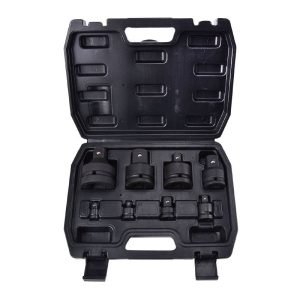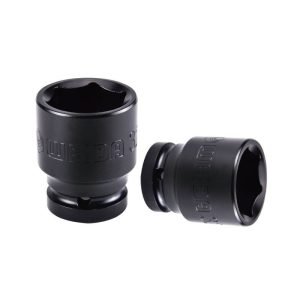
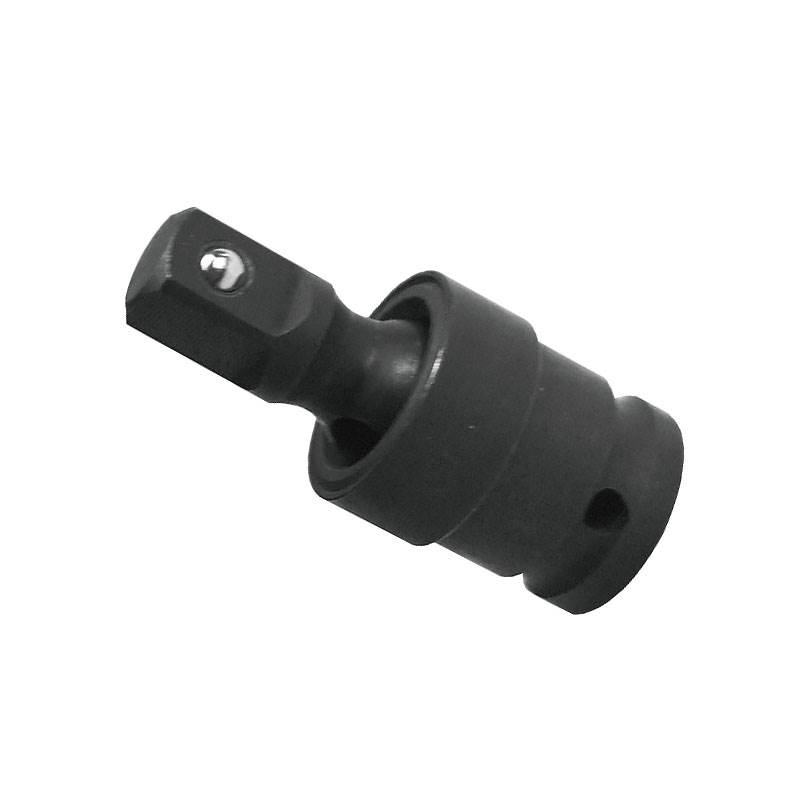
Product Description
Product Features
1. CRMO Steel Cold-Forged — Superior Strength
2. Universal Ball Head — Multi-Angle Transmission
3. Shock-Resistant Structure — Built for Impact Wrenches
4. Four Sizes — Full Series Coverage
5. Surface Treatment — Rust & Wear Resistant
6. Precision Machining — Tight Fit
Specifications
| Product No. | Drive Size | Equivalent Inch | Box Qty | Carton Qty | Unit Weight | Gross Weight |
|---|---|---|---|---|---|---|
| W54059 | 10mm | 3/8″ | 8 pcs | 192 pcs | 0.09 kg | 18.28 kg |
| W54060 | 12.5mm | 1/2″ | 6 pcs | 96 pcs | 0.17 kg | 17.32 kg |
| W54061 | 20mm | 3/4″ | 2 pcs | 32 pcs | 0.59 kg | 19.88 kg |
| W54062 | 25mm | 1″ | 1 pc | 20 pcs | 1.05 kg | 22.00 kg |
Technical Specifications
| Parameter | Details |
|---|---|
| Material | CRMO Chromium-Molybdenum Steel |
| Process | Cold-Forged |
| Design | Universal Ball Head |
| Surface Finish | Black Oxide / Sandblasted |
| Grade | Impact Grade (For Air Wrenches) |
| Swivel Angle | Approx. 30°± |
| Drive Type | Female Square × Male Square |
Applications
- Automotive Repair: Deep engine bay bolts, chassis suspension bolts, exhaust system — tight space removal
- Mechanical Assembly: Internal equipment fasteners, offset-position bolts, hard-to-reach area assembly
- Heavy Equipment: Repair of complex components on excavators, loaders, and heavy machinery
- Commercial Vehicle Service: Truck chassis, transmission, drivetrain — multi-angle bolt removal
- Plant Maintenance: Production equipment internal inspection, hard-to-reach fastener service
- Mold Repair: Deep and angled screw removal inside molds
- DIY Modification: Auto and mechanical modification work in space-limited areas
Why Choose Us
Direct-from-source factory with controllable quality.
Factory-direct supply, price advantage.
Full range of specifications, one-stop procurement.
Supports OEM and flexible customization.
Extensive experience in foreign trade exports.
FAQ
A: They’re very different and not interchangeable: ① Material — impact universal joints use CRMO steel for superior impact resistance; manual joints typically use Cr-V or carbon steel, suitable only for static torque. ② Construction — impact joints have reinforced internal balls and springs built to withstand impact; manual joints have lighter construction that quickly comes apart or breaks when used with impact wrenches. Manual universal joints should never be used with pneumatic/electric impact wrenches — they can shatter and fly apart, causing injury. Impact universal joints work fine with hand tools (they’re just overbuilt for it).
A: Choose the size that matches your impact wrench drive: 10mm (3/8″) for small-to-medium impact wrenches, mainly for auto maintenance and medium-torque jobs; 12.5mm (1/2″) is the most common size — essential for auto repair shops with the widest range of applications; 20mm (3/4″) and 25mm (1″) are heavy-duty sizes for large impact wrenches and big air guns, suitable for trucks, construction machinery, and heavy equipment high-torque repair.
A: The maximum pivot angle is approximately 30 degrees. We recommend not using extreme angles: ① the greater the angle, the lower the transmission efficiency — actual torque reaching the bolt is reduced; ② excessive angles accelerate ball head wear, shortening service life; ③ high-angle impact increases the risk of disengagement. For jobs requiring sharp angles, use an extension bar alongside the universal joint to keep the joint working within a small angle range — protecting your tool and preserving torque.
A: Under proper use, CRMO steel cold-forged impact-grade universal joints are extremely durable and can last for years. These conditions accelerate damage: ① using on mismatched size wrenches (small size with high-torque wrench); ② continuous impact at extreme angles; ③ overloading by trying to remove severely rusted bolts; ④ lack of lubrication causing dry wear on the ball head. Periodically check for ball wear and spring fatigue — replace if looseness is detected to prevent disengagement during use.
A: They serve different functions: a universal joint changes drive direction, allowing sockets to turn bolts at an angle — mainly for space-constrained and angled bolt situations; an extension bar extends working reach, allowing sockets to reach deeper positions — mainly for depth access problems. In practice, they’re often used together — extension + universal joint + socket — solving both depth and angle challenges, making them the golden combo for auto repair and mechanical service.